Franklin, WI and nearby

Tell us about the door

A few details are enough to get started. We'll follow up to confirm what you need and when we can come out.

We use these details only to reply to your request.

Repairs

Overhead Garage Door Repair in Franklin

“Overhead door” is the trade’s name for any door that rolls up and back along the ceiling. This page is for the ones that don’t fit the usual mold: tall doors, wide doors, shop doors, and the doors on outbuildings.

(000) 000-0000
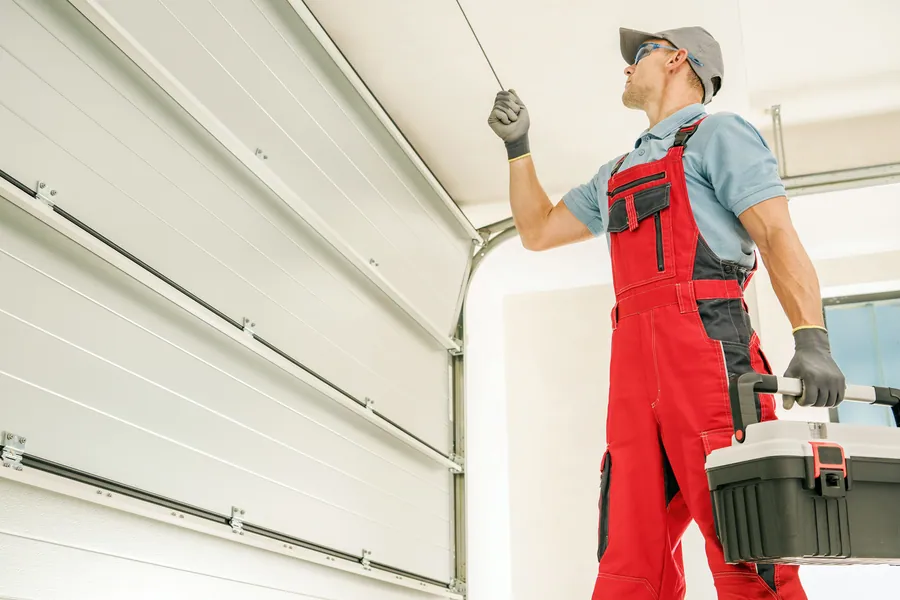
Technician in red overalls carrying a toolbox beneath an open overhead door
Covers
Homes, shops and outbuildings
Track types
Standard, low-headroom, high-lift
Oversized doors
Yes

Which doors we mean

Most of the pages on this site talk about the 16-by-7 door on an attached garage, because that’s what most people have. But Franklin still has plenty of larger lots, particularly south of Ryan Road and out toward Muskego and Raymond, and those properties have other buildings: a detached shop, a pole shed for the tractor and the boat, a tall bay for the camper.

The doors on those buildings are overhead sectional doors too, built on the same principles. They differ in size, in how the track is laid out and in how much attention they’ve had. Which is often none.

The anatomy of an overhead door

It helps to know what you’re looking at. Every sectional overhead door has the same five systems.

  • The curtain The hinged sections themselves, with struts across the back for stiffness on wider doors.
  • The guide system Vertical track, a curved radius, and horizontal track, plus the rollers that ride in them.
  • The counterbalance Torsion springs on a shaft above the door, or mounted at the rear on some low-headroom setups, with drums and cables that carry the weight.
  • The seals Bottom rubber, jamb seals, and a header seal.
  • The operator A motor, if there is one. Plenty of shed doors are still lifted by hand with a pull rope or a chain hoist.

A problem in one system shows up as symptoms in another. A door that won’t stay open has a counterbalance problem. A door that rubs has a guide problem. A door that leaks daylight has a seal problem, or sometimes a guide problem that looks like one.

Track layouts you won’t see on a typical house

How the track is arranged depends on how much room is above the door. This matters for repairs because the springs, drums, and cables differ for each.

Layout Where you find it What’s different
Standard lift Most attached garages Door turns back just above the opening. Needs about a foot of headroom.
Low headroom Garages with a beam, duct, or low ceiling above the door Double horizontal track, sometimes rear-mounted springs. Tighter tolerances.
High lift Shops with tall ceilings Door rises vertically past the opening before turning back. Uses stepped drums and longer cables.
Vertical lift Buildings with a lot of height above the door Door goes straight up the wall. No horizontal track at all.
Follow-the-roof Pole buildings and sheds with pitched ceilings Horizontal track angled to match the roof slope. Special drums and spring calculations.

High-lift and roof-pitch doors are the ones we most often find set up incorrectly. The drums are shaped to change the leverage as the door travels, and if the cable is started in the wrong groove or the springs are wound to a standard-lift turn count, the door will be heavy at one point and light at another. It works, sort of, and wears everything out early.

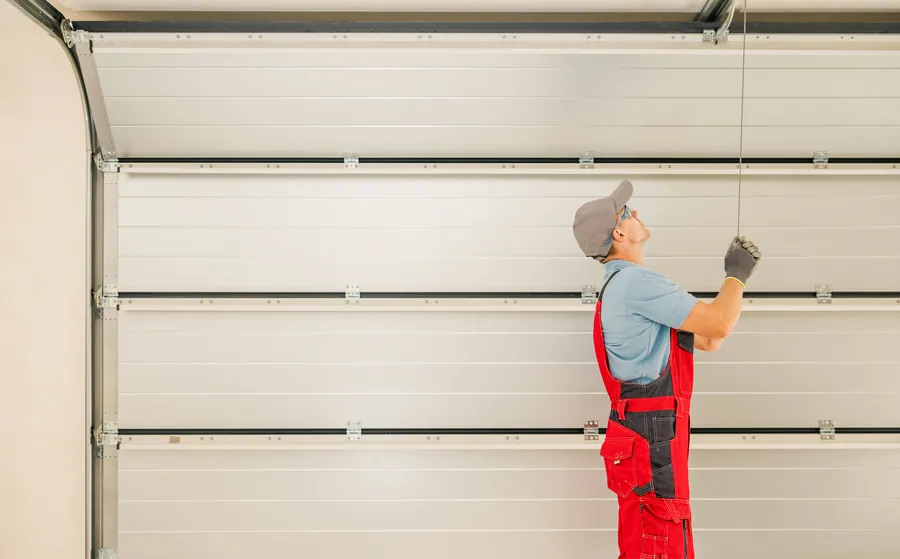
White overhead sectional door seen from inside a utility garage
Reference photo: white overhead sectional door seen from inside a utility garage.

Common trouble on shop and outbuilding doors

Years without lubrication or adjustment

An outbuilding door might run twice a week. Because it works, nobody looks at it. Rollers dry out, hinges wear, and spring tension slowly drops. By the time it gets attention, there are usually several things to fix at once.

Wind damage

A 12-foot-tall door on a pole building in open country catches a great deal of wind. Sections bow, rollers pull out, and struts bend. If your door faces west across a field, extra struts and heavier track are cheap insurance.

Doors that are too heavy to lift

Manual doors depend entirely on spring balance. As the springs weaken, the door gets heavier until someone ends up straining a shoulder to open it. A manual door, like any other, should lift with one hand.

Rust

Unheated buildings on gravel or dirt pads are damp. Condensation forms on cold steel every time the weather changes. Springs, cables, and the bottom section corrode faster than they would in an attached garage.

Settling

Post-frame buildings move. Posts settle unevenly, slabs crack, and headers sag. An opening that was square when the door was installed may be a parallelogram now, and the door binds on one side.

Critters

Mice like the foam in insulated sections and the warm housing of an operator. They chew sensor wires and nest in the track. It sounds like a joke until you’re tracing a chewed-through wire on a January afternoon.
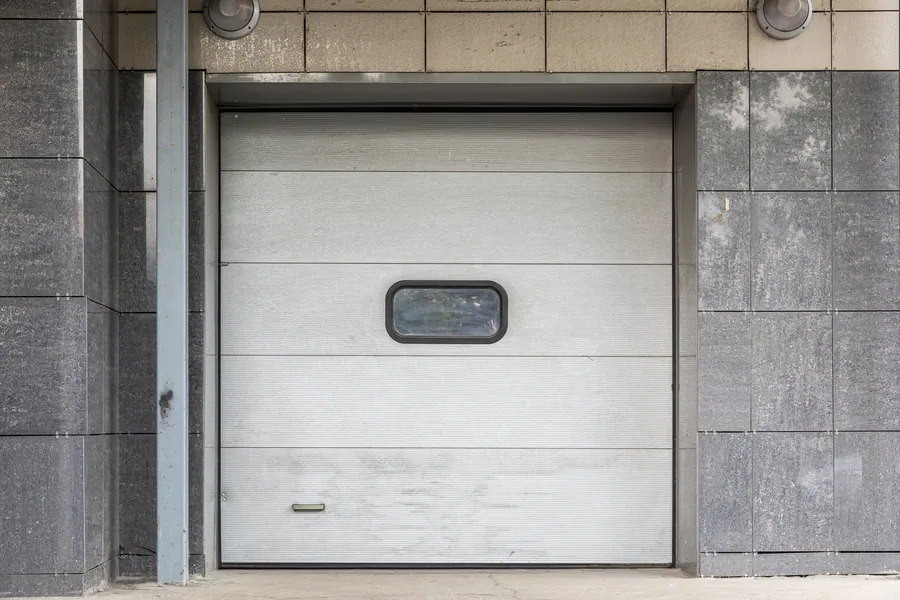
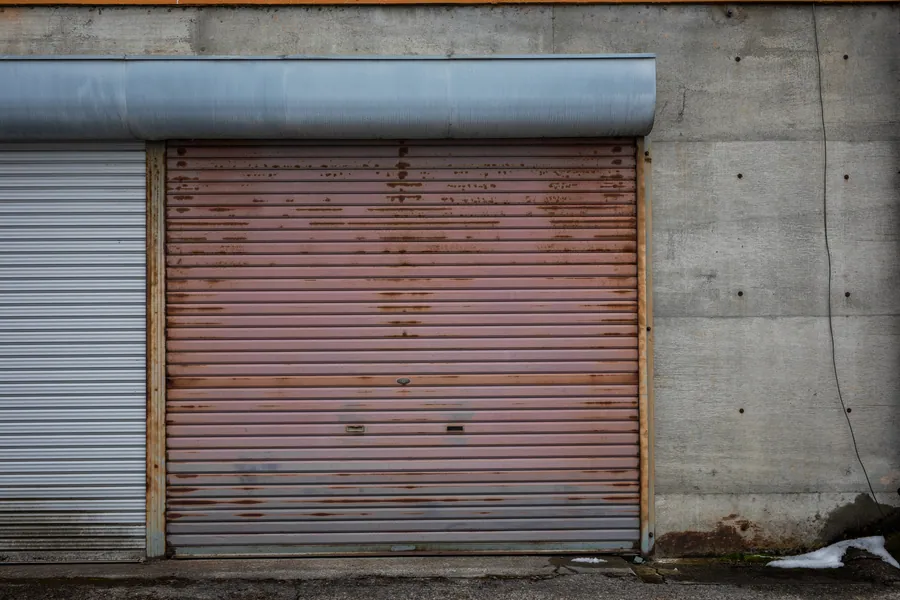
Before and after

A rusted door on a concrete building and a sound sectional overhead door

The before image shows a steel door on a concrete building that has rusted across most of its face. This is what years of damp, unheated conditions do when a door gets no attention. Corrosion like this usually extends to the springs, cables, and guides behind it.

The after image shows a light gray sectional overhead door in good order, sitting flat in its opening. For a door like the first, the choice is between a rebuild with new sections and hardware, or a replacement door on new track. Either way, the result is a door that seals, balances properly, and can be opened without a struggle.

After: Light gray sectional overhead door with a vision window in a concrete wall
Before: Rusted roll-up door on a stained concrete building
Before After
Illustrative comparison using licensed stock photography. It shows the kind of change this service makes and is not a documented customer project.

How we approach the repair

We start with the same hand test as on any door. Disconnect the operator if there is one, lift the door, and feel what it’s doing. On a tall door, we check the balance at several heights, because a high-lift or pitched-track door can be right at the bottom and wrong at the top.

Then we measure. Door size and weight, drum type, cable length, spring dimensions, and the track layout. On outbuilding doors, we don’t assume the existing parts are correct, since many have been patched with whatever was available.

Repairs are quoted before work begins. Typical jobs include:

  • Replacing and correctly sizing torsion springs for the door and lift type
  • New cables, drums, and bearings
  • Roller and hinge replacement
  • Adding struts to wide or wind-exposed doors
  • Realigning or replacing track, and shimming it to suit a building that has moved
  • New bottom seal and perimeter weatherstripping
  • Replacing damaged sections where a match is available
  • Installing or repairing an operator, or adding a chain hoist to a manual door

Oversized parts aren’t always on the truck. If your door needs something we don’t carry, we’ll make the door safe, order the part, and come back.

Adding an opener to a manual door

Many shop doors were installed as manual doors to save money. Adding an operator later is simple enough if the door is balanced and the building has power near the opening.

For tall doors and high-lift track, a jackshaft operator mounted beside the door is usually the right choice. It turns the spring shaft directly and needs no rail. For standard-lift doors, a trolley operator works well. If there’s no power, a chain hoist lets you gear the lift down so the door can be opened easily by hand. Our opener installation page covers residential units, and commercial repair covers the heavier operators.

Unheated buildings in a Wisconsin winter

An outbuilding door lives a harder winter than a house door.

There’s no warmth leaking in from a heated wall, so the door, track, and springs sit at outdoor temperature for months. Lubricant stiffens. Use a product rated for low temperatures on rollers, hinges, and springs before the cold arrives, and avoid heavy grease, which turns to paste.

Frost heave is more pronounced on floating slabs and gravel aprons. If the bottom of the door seals well in summer and shows a gap in February, the slab or the apron has moved. A taller, softer bottom seal accommodates a lot of that.

Snow drifts against doors that aren’t used daily, then melts and refreezes along the bottom. Shovel it back from the door before trying to open it, and don’t force a door that’s frozen down. Bottom sections fold, and on a tall door the cables can jump the drums when the load suddenly releases.

Condensation is the quiet one. A cold steel building on a mild, damp day will sweat on every surface. A light oil film on springs and cables each fall slows the rust that follows.

When the door is past repairing

Some outbuilding doors have simply aged out: sections rusted through at the bottom, wood doors that have rotted, track that has corroded where it meets the floor. If repair doesn’t make sense, we’ll say so and measure for a new one. An insulated replacement can change how usable an unheated shop is. See garage door installation for how that works, and track repair if the main issue is alignment.

Questions we hear

Overhead Garage Door Repair: common questions

What’s the difference between an overhead door and a garage door?

Mostly the name. “Overhead door” describes how it opens, up and back along the ceiling. It’s used for residential garage doors and for larger doors on shops, barns, and commercial buildings alike.

Can you work on doors taller than a standard garage door?

Yes. We service 8, 10, 12, and 14 foot doors, including high-lift and vertical-lift track. Let us know the size so we arrive with the right equipment.

My shed door is manual and very heavy. Is that normal?

No. A balanced manual door lifts easily with one hand. If yours is heavy, the springs have weakened or were never correct for the door.

Can a motor be added to my shop door?

In most cases. The door needs to be balanced first, and there has to be power nearby. We’ll recommend an operator that suits the door’s height and track layout.

Why does my door bind in winter but not in summer?

The building has likely shifted with frost, or the track fasteners have loosened as the framing dried. Realigning the track usually sorts it out.

Do you service doors on pole buildings?

Yes, including roof-pitch track, which needs particular attention to drum type and spring settings.

Estimates for Franklin and nearby

Shop or outbuilding door giving you trouble?

Send the form or call, whichever is easier. Tell us what the door is doing and we'll explain what we'd check first, what the likely fixes are, and what happens next.

(000) 000-0000

We use these details only to reply to your request.

Call