Franklin, WI and nearby

Tell us about the door

A few details are enough to get started. We'll follow up to confirm what you need and when we can come out.

We use these details only to reply to your request.

Springs

Garage Door Spring Repair in Franklin

A loud bang from the garage, then a door that suddenly weighs as much as a refrigerator. That’s a broken spring, and it’s the single most common repair call we take.

(000) 000-0000
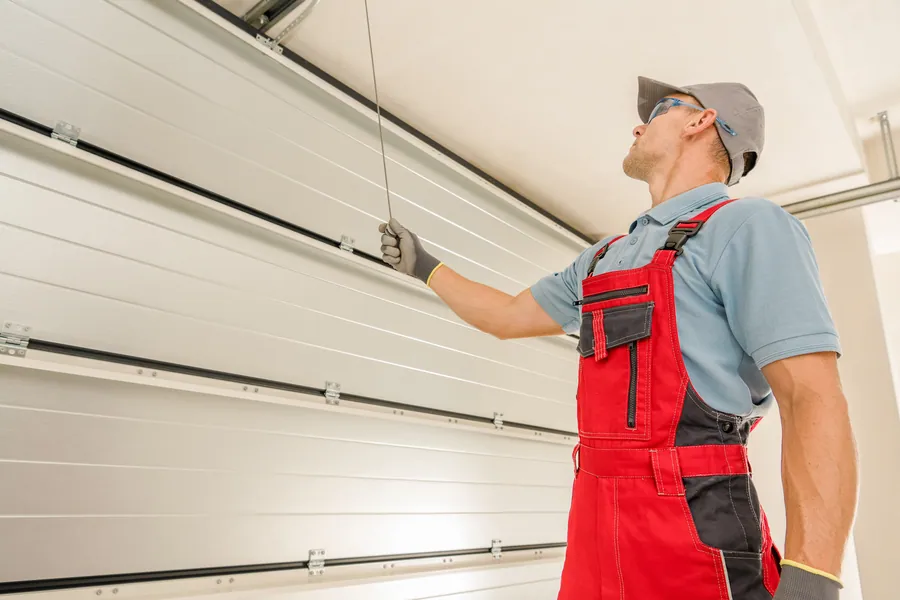
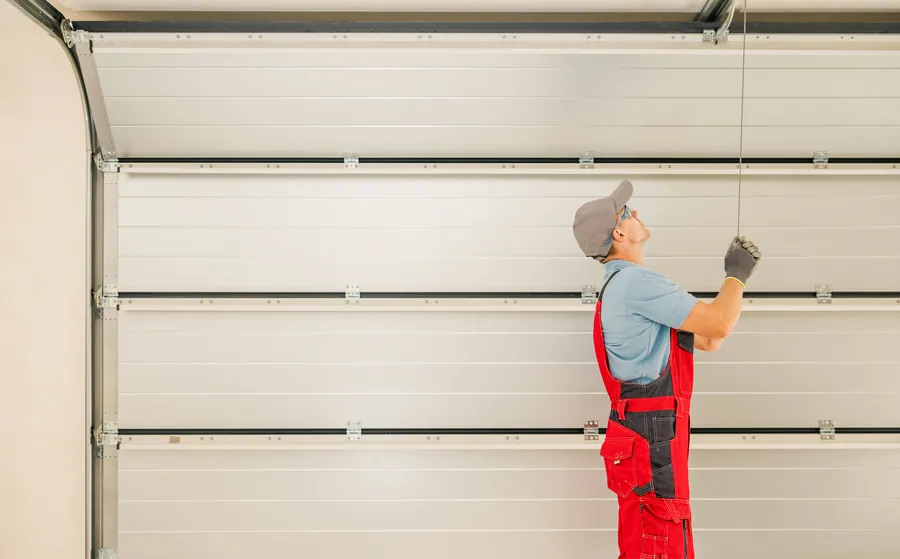
Technician in red overalls testing a sectional garage door by its pull cord
Standard spring life
About 10,000 cycles
Replace as
A matched pair
Balance test
Every job

What the springs actually do

The opener doesn’t lift your garage door. The springs do. A typical insulated double door in a Franklin subdivision weighs 150 to 200 pounds, and the springs are wound or stretched to cancel out almost all of that. The opener only has to nudge a door that’s already close to weightless.

When a spring breaks, that help disappears in an instant. The opener strains, moves the door a few inches, and gives up. Sometimes it doesn’t move the door at all. If the door happened to be open, it can come down hard.

Torsion and extension springs compared

Homes around here have one of two systems. A quick look above and beside the door will tell you which.

Torsion springs Extension springs
Where they sit On a steel shaft above the door opening Along the horizontal tracks, one per side
How they work Twist to store energy, turn drums that wind the cables Stretch as the door closes, pull through pulleys
Typical on Most doors installed in the last 25 years, nearly all double doors Older single doors and some lightweight builder doors
When one breaks You’ll see a gap of an inch or two in the coil The spring hangs slack or whips loose if there’s no safety cable
What we check with them Center bearing, end bearings, drums, shaft Pulleys, safety cables, the track hangers

If you have extension springs without a safety cable threaded through the middle, tell us. That cable is what keeps a broken spring from flying across the garage, and adding one is inexpensive.

Signs a spring is failing or already gone

  • A sharp bang from the garage, often overnight when the temperature falls
  • A visible gap in the coil above the door
  • The opener lifts the door six inches and stops
  • The door feels very heavy when you pull the release and lift by hand
  • The top section bends inward as the opener tries to pull
  • Cables hanging loose beside the door
  • The door closes faster than it used to, with a thud at the floor

The last one is worth noticing early. Springs lose tension gradually before they break. A door that drifts down when you leave it half open is telling you the springs are near the end.
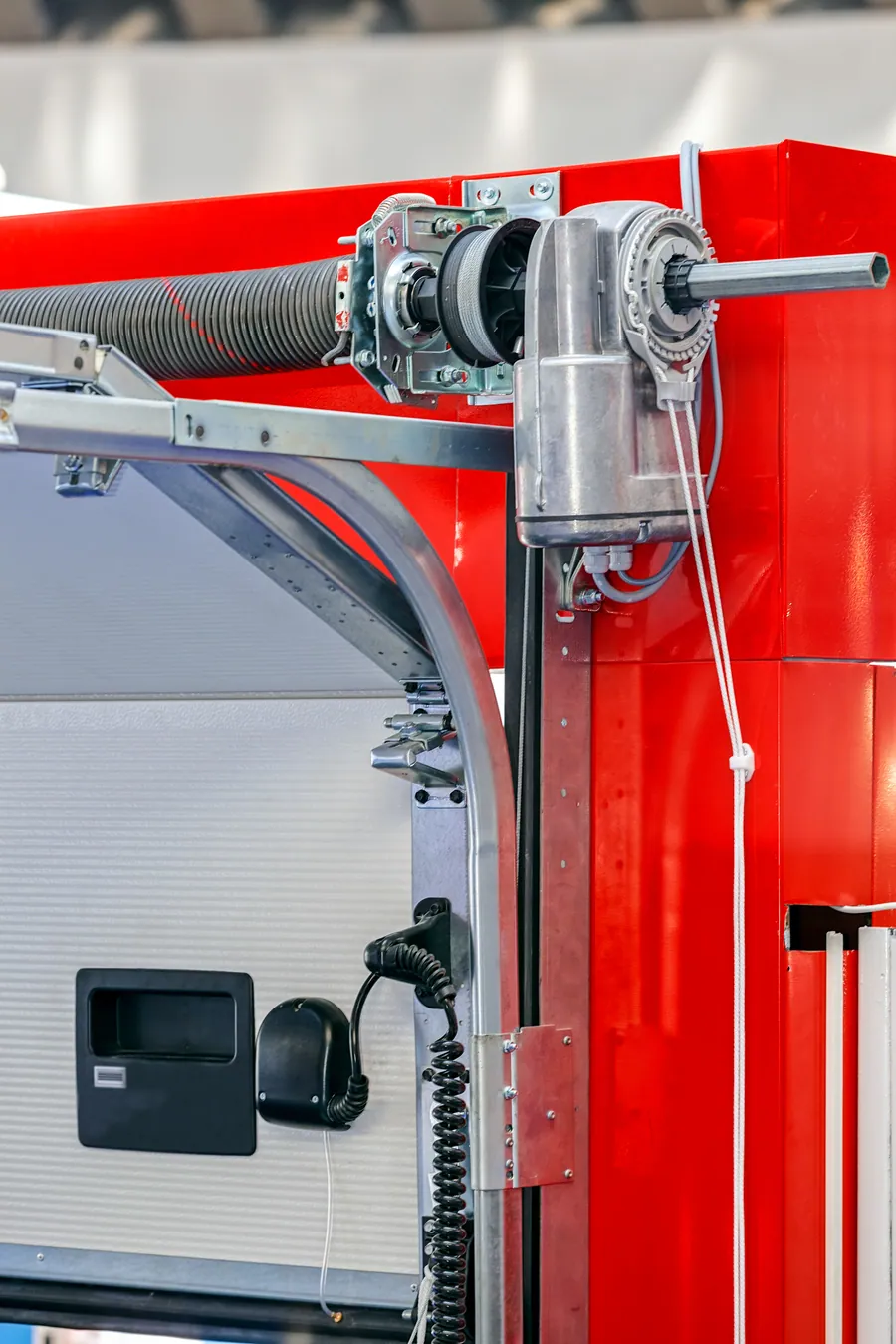
Torsion spring shaft, cable drum and operator mounted beside a sectional door
Reference photo: torsion spring shaft, cable drum and operator mounted beside a sectional door.

Why we size springs instead of matching the old ones

It’s tempting to measure the broken spring and order the same thing. The trouble is that the old spring may have been wrong from the start, or right for a door that has since gained weight from added insulation, a new bottom section, or decades of paint.

We size from the door, not from the previous spring. That means weighing the door or calculating its weight from the construction, measuring the height and the drum size, and choosing a wire diameter, inside diameter, and length that produce the right lift through the full travel. On a two-spring door, we replace both at once. The pair has done the same number of cycles, so the second one is never far behind the first, and mismatched springs make the door hard to balance.

Cycle life, in practical terms

A cycle is one open and one close. Standard residential springs are rated around 10,000 cycles. If the garage is your front door, as it is for most families here, four to six cycles a day add up to about five to seven years. Higher-cycle springs use more steel to spread the stress and can last considerably longer. They cost more up front, and we’ll tell you whether they make sense for how you use the door.
Before and after

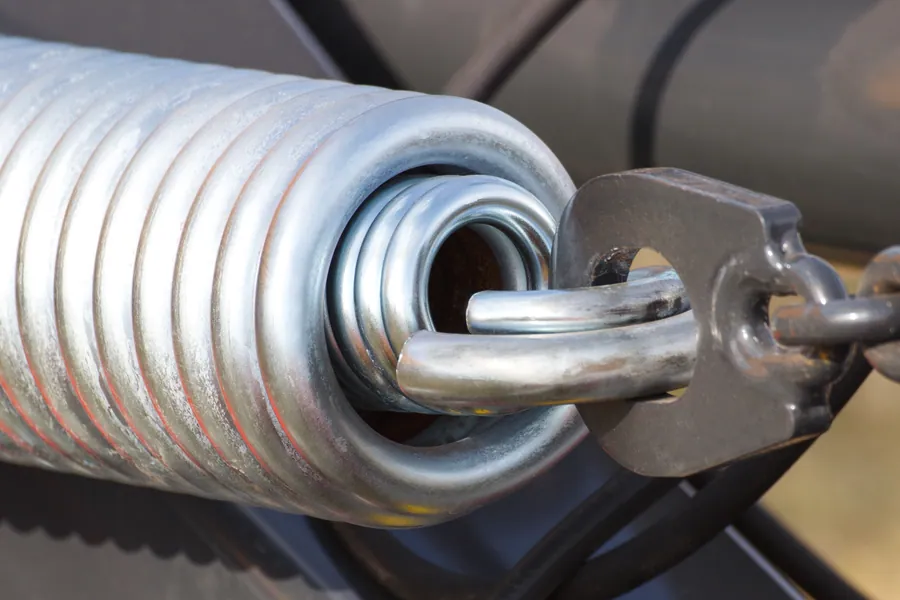
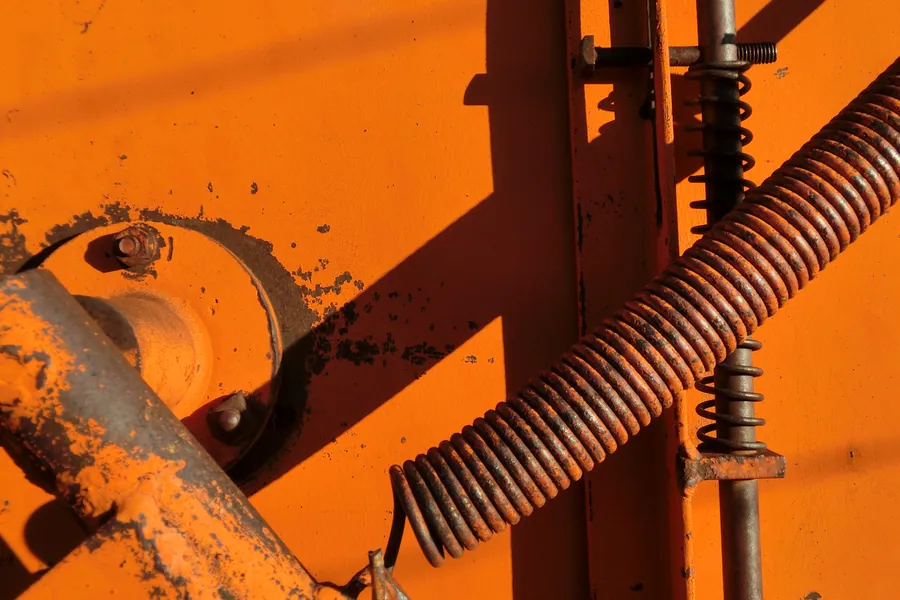
A fatigued, rusted spring next to a properly sized replacement

Before, the picture is of what a spring looks like near the end of its life: surface rust along the coils and the dull, pitted finish that comes from years of moisture and salt. Springs in this condition often still work, right up until a cold night finishes them off.

After, the picture is of new, properly sized spring steel with clean coils. In an actual replacement, both springs are changed together, the bearings and drums are inspected while the shaft is apart, and the door is balance-tested at three heights. The practical difference is a door that lifts evenly and an opener that no longer strains.

After: Clean, bright steel coil spring with its end hook attached
Before: Rusted coil spring and corroded steel hardware
Before After
Illustrative comparison using licensed stock photography. It shows the kind of change this service makes and is not a documented customer project.

How a spring replacement goes

  1. Secure the door. We clamp the track so the door can’t move, unplug the opener, and confirm which springs are broken and which are still loaded.
  2. Unwind what’s left. We release any spring still under tension with winding bars, a quarter turn at a time.
  3. Remove and inspect. With the shaft free, we check the center and end bearings, the drums for worn grooves, and the cables for broken strands.
  4. Install the new springs. Correct wind direction on each side, set screws seated on the shaft, cables tensioned evenly.
  5. Wind and balance. We wind to the turn count for the door height, then test: the door should hold at knee, waist, and shoulder height without drifting.
  6. Reset the opener. We check the travel limits and closing force so the safety reverse works on the newly balanced door.
  7. Lubricate and walk you through it. A light coat on the coils cuts noise and slows rust. We show you the balance test so you can repeat it yourself.

Cold weather and spring failures

Ask anyone who does this work in southeastern Wisconsin when the phone rings most, and they’ll say the first hard cold snap. Spring steel loses some of its resilience as the temperature drops, and a coil that has been fatiguing quietly for years finally cracks. Garages on the north side of a house, and detached garages with no heat bleeding in from the home, see it most.

Rust speeds things up. Moisture from wet cars and road salt pits the surface of the wire, and each pit is a place for a crack to start. A spray of garage door lubricant on the coils twice a year, once before winter and once in spring, makes a real difference. It’s the cheapest maintenance there is.

Please don’t do this one yourself

We’re not being dramatic. A wound torsion spring holds enough energy to lift a 200-pound door seven feet. That energy is released through whatever is holding the winding cone, and if that’s a screwdriver instead of a winding bar, or a hand in the wrong place, the injuries are serious. Emergency rooms see them every year.

Extension springs are no gentler. They’re stretched to roughly twice their length when the door is down, and the pulleys and cables carry that load too.

If your spring breaks, here is the safe short list. Leave the door where it is. Don’t run the opener. Don’t pull the release cord if the door is open. Keep kids and cars out of the doorway, and call.

After the repair

A correctly sprung door is quiet and light. You should be able to lift it with one hand and feel the same effort from floor to header. The opener will sound less strained, and it will last longer because it’s no longer doing the springs’ job.

While we’re there, we check the parts that share the load. Cables and bottom brackets take a beating when a spring lets go, so see our cable repair page if yours look frayed. If the door has other issues, the general garage door repair page covers how we diagnose them, and a yearly tune-up is the best way to catch a tired spring before it strands a car.

Questions we hear

Spring repair: what people ask us

Can I open the door with a broken spring?

We’d rather you didn’t. Two adults can sometimes lift a single door by hand, but the full weight is on you and there is nothing to hold it up. If the car has to come out, call first and we’ll advise.

Why did only one of my two springs break?

They rarely fail on the same day, but they’ve done the same work. The unbroken one is usually close behind, which is why we replace the pair and keep the door balanced.

How long does spring replacement take?

Most torsion spring jobs take about an hour once we’re on site, a little longer if bearings or cables need replacing too.

Are high-cycle springs worth the extra cost?

If the garage door is how your family comes and goes, often yes. If the door opens once a day, standard springs will serve you well for years.

My door has one spring. Should it have two?

Many single doors are designed for one. Heavier doors benefit from two, because the load is shared and the door stays up if one breaks. We’ll look at the weight and tell you what suits it.

What causes springs to rust so quickly here?

Wet cars, road salt, and an unheated garage. Condensation settles on cold steel, and salt keeps it damp. Regular lubrication slows it down a lot.

Estimates for Franklin and nearby

Heard the bang? We'll get the door lifting again.

Send the form or call, whichever is easier. Tell us what the door is doing and we'll explain what we'd check first, what the likely fixes are, and what happens next.

(000) 000-0000

We use these details only to reply to your request.

Call