Franklin, WI and nearby

Tell us about the door

A few details are enough to get started. We'll follow up to confirm what you need and when we can come out.

We use these details only to reply to your request.

Repairs

Garage Door Repair in Franklin, WI

Most doors give you a warning before they quit: a new noise, a shudder halfway up, a gap along the floor. Tell us what yours is doing and we’ll track down the part behind it.

(000) 000-0000
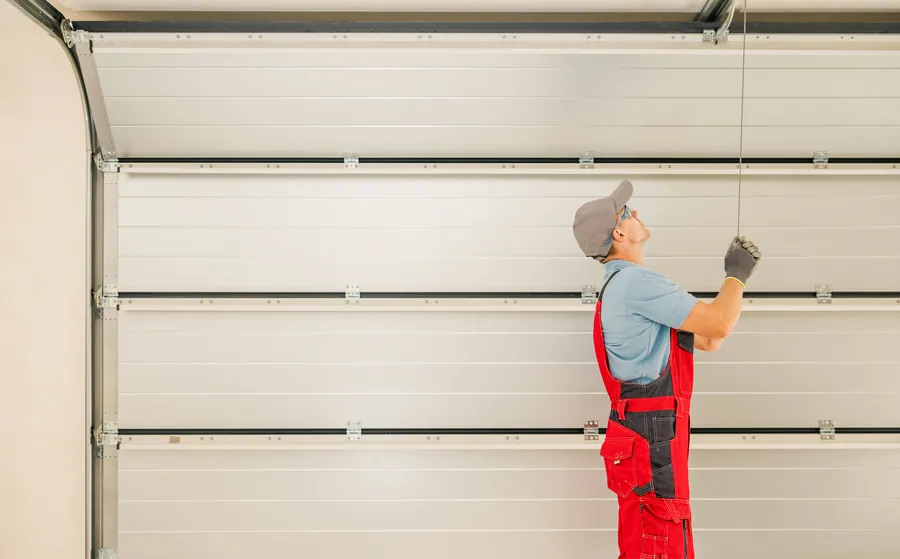
Garage door technician in red overalls inspecting the inside of a sectional door
Most common cause
Worn or broken spring
First check
Door balance
Works on
All major door brands

Start with what the door is doing

You don’t need to know the name of the part. A good description of the symptom usually narrows the problem to two or three suspects before we even open the truck. Here is how the most common complaints tend to sort out.

What you notice Usual suspects What the fix involves
Opener hums, door lifts a few inches and stops Broken torsion spring New spring matched to the door’s weight, then a balance test
Door hangs lower on one side Cable off the drum or a frayed cable Re-hang or replace cables, inspect drums and bottom brackets
Door closes, touches the floor, and goes back up Photo-eyes out of line, or close-limit set too far Realign sensors, reset travel and force
Loud bang, then nothing works Spring failure, sometimes a snapped cable Replace the failed part, check everything it was attached to
Shaking or binding partway up Worn rollers, loose hinges, track out of plumb Replace rollers, tighten or replace hinges, set the track
Works in July, struggles in January Stiff grease, weak springs, seal frozen to the slab Clean and re-lubricate, rebalance, replace the bottom seal

The table is a starting point, not a diagnosis. Two doors with the same symptom can have different causes, which is why we look at the whole system before quoting anything.

How we work through a repair

Every visit begins the same way. We disconnect the opener and lift the door by hand. A healthy residential door should rise with one hand and stay put when you let go at waist height. If it drops or shoots upward, the springs are either tired or wound wrong, and nothing else on the door will behave until that’s sorted.

From there, we follow the load path: springs, the torsion shaft and bearings, drums, cables, bottom brackets, then rollers, hinges, and track. The opener comes last. That order matters. Openers get blamed for a lot of problems they didn’t cause, and replacing a motor on a door that’s 40 pounds out of balance just gives you a new motor that wears out early.

Once we know what failed and why, we explain it in plain terms and give you a price before any work starts. If there’s a cheaper fix that will hold and a more thorough one that will last longer, you’ll hear both.
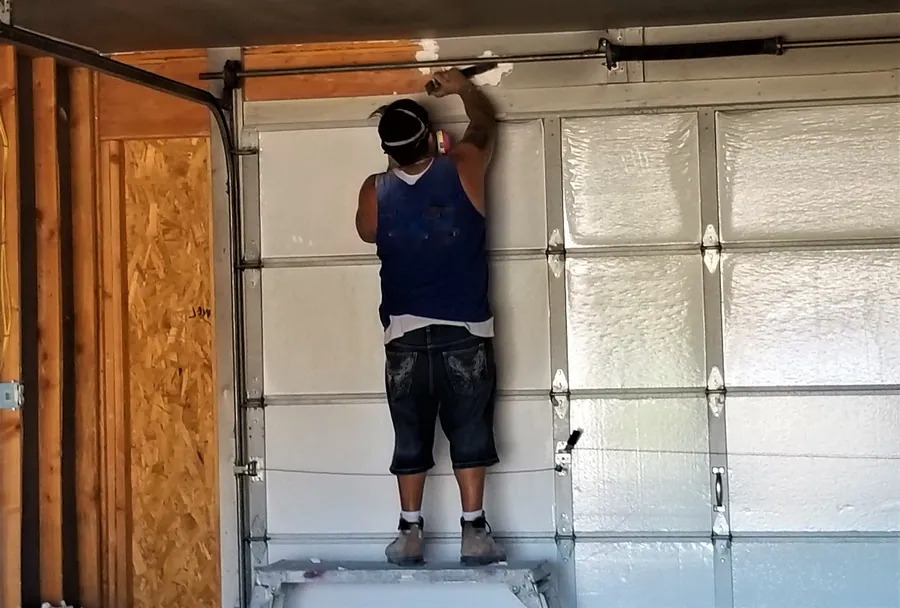
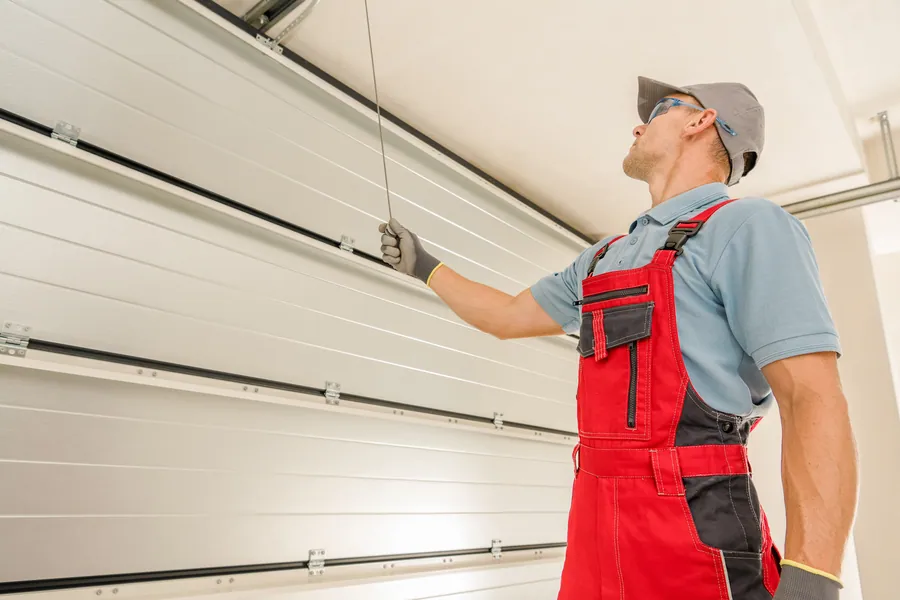
Technician on a platform working on the hardware above an insulated garage door
Reference photo: technician on a platform working on the hardware above an insulated garage door.

Repairs we handle most often

Franklin has a lot of attached two- and three-car garages built from the 1970s through the 2000s, and the doors on them tend to wear out in a predictable order.

  • Springs Torsion springs above the door and extension springs along the tracks. See our spring repair page for the details.
  • Cables and drums Frayed strands, cables that jumped the drum, and rusted bottom brackets. More on our cable repair page.
  • Rollers and hinges Cracked nylon, seized bearings, and hinges that have worn their pin holes into ovals.
  • Tracks Bent verticals from a bumper tap, loose lag screws, and horizontal track that has drifted out of level.
  • Weather seals Bottom rubber, the retainer that holds it, and the vinyl stops along the sides and top.
  • Opener issues Stripped gears, dead remotes, sensor wiring, and logic boards, covered on our opener repair page.

Repair or replace?

Most of the time, repair is the right call. Steel sections that are still straight and rust-free will outlast several sets of springs and rollers. We lean toward repair when the damage is limited to hardware, the sections are straight, and parts are still made for that model.

Replacement starts to make sense when several things pile up at once: rust eating through the bottom section, cracked stiles where the hinges mount, a discontinued panel design, or a wood door that has taken on water and gained weight. If the repair estimate creeps past roughly half the cost of a comparable new door, we’ll say so and let you decide. We don’t have a quota of doors to sell.
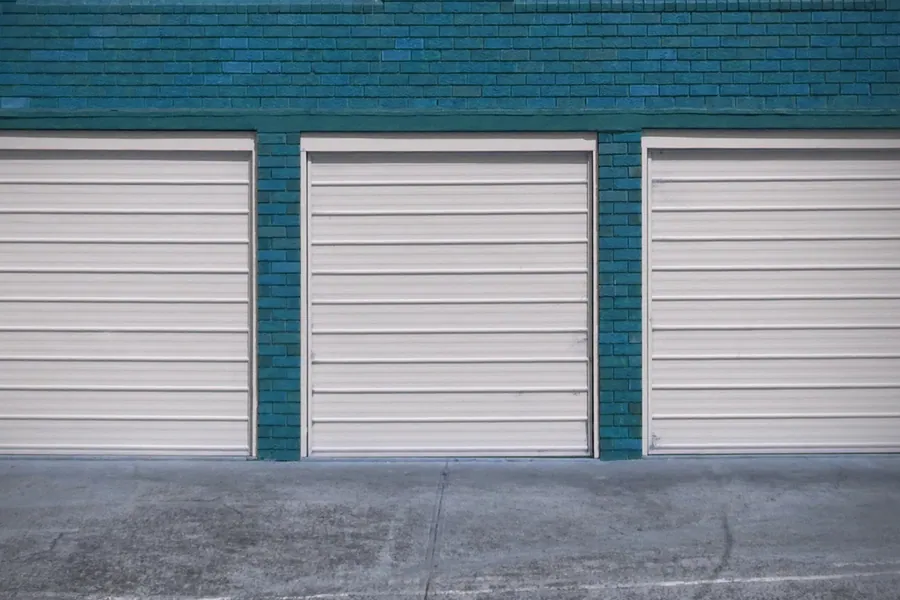
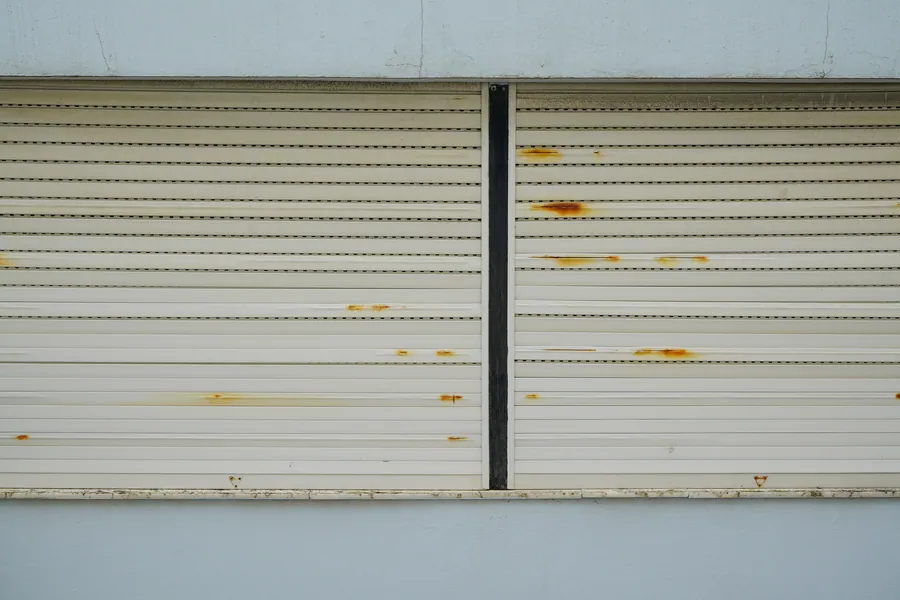
Before and after

Rust-streaked, neglected doors and a clean, well-kept set

In the before photo, you can see a pair of roll-up doors that have been left to themselves: rust streaks running down from the fasteners, grime on the slats, and a finish that has chalked. Staining like this usually points to more than looks. Water is getting where it shouldn’t, and the hardware behind the door is often in similar shape.

In the after photo, you can see a row of clean, evenly aligned doors. Getting a neglected door back to that standard typically means treating the corrosion, renewing springs, cables, and rollers that have worn, resetting the track so both sides carry the load, and adjusting the opener to suit. What you should notice afterward is an even gap along the floor and a door that lifts with one hand.

After: Three clean, evenly aligned roll-up doors on a blue-green wall
Before: Two older roll-up doors with rust streaks and grime on the slats
Before After
Illustrative comparison using licensed stock photography. It shows the kind of change this service makes and is not a documented customer project.

What Wisconsin winters do to a door

Cold changes how a garage door behaves in ways that surprise people who are new to the area.

Steel gets less forgiving when the temperature drops. A torsion spring that has been cycling for ten years is far more likely to let go on a five-degree morning than in May. The grease that kept the rollers quiet all summer thickens, so the opener has to push harder. Meltwater from the car runs to the threshold, refreezes overnight, and glues the bottom seal to the concrete. The opener pulls, the seal tears or the top section bends, and now there are two repairs instead of one.

Road salt is the slower problem. It rides in on tires, pools at the bottom corners, and works on the bottom brackets, the lowest roller stems, and the last few inches of cable. We check those spots on every Franklin repair between November and April because that’s where winter damage hides.

A few habits help: keep the threshold clear of slush, wipe down the bottom seal now and then, and don’t keep hitting the button if the door is stuck. Pull the release cord and call instead.

Why this is rarely a good do-it-yourself job

Plenty of garage door upkeep is homeowner-friendly. Lubricating rollers, wiping the photo-eye lenses, and replacing a remote battery are all fair game.

Anything attached to the spring system is different. A standard double door weighs somewhere between 130 and 200 pounds, and the springs hold enough stored energy to lift all of it. The bottom brackets, cables, drums, and the center bearing plate are under that tension whenever the door is down. Loosening the wrong fastener can release it at once. We use proper winding bars, clamp the door before touching the counterbalance, and replace parts in a sequence that keeps the load controlled. It isn’t complicated work for someone who does it daily. It’s unforgiving for someone doing it once.

Before we arrive

If the door is stuck open, don’t pull the emergency release with the door up unless you’re sure the springs are intact. A door with a broken spring will come down fast. If it’s stuck closed with the car inside and you need to leave, we can talk you through whether it’s safe to lift by hand.

It also helps to have a few details ready: the door’s width (single or double), whether it’s insulated, roughly how old it is, and the brand of opener. A photo of the spring area above the door tells us a lot. With that, we can often bring the right parts on the first trip.

Service around Franklin

We work throughout Franklin, from the neighborhoods off Drexel and Rawson to the newer subdivisions toward Ryan Road, and in nearby Oak Creek, Greendale, Hales Corners, and Muskego. If your door needs more than a repair, our replacement and maintenance pages explain those options.

Questions we hear

Garage Door Repair: common questions

How do I know whether the problem is the door or the opener?

Pull the red release cord with the door closed and try lifting it by hand. If it’s smooth and light, the door is fine and the opener needs attention. If it’s heavy, crooked, or won’t budge, the trouble is in the springs, cables, or track.

Is it safe to keep using a door that’s making a new noise?

A new squeak is usually just dry rollers. A bang, a grinding sound, or a door that jerks is different. Stop using the opener, leave the door closed if you can, and have it looked at before something else breaks.

Do you repair every brand of door?

Yes. Residential sectional doors share most of their hardware, so springs, cables, rollers, and hinges can be sized for nearly any make. Brand matters mainly when a section or a specific opener part has to be matched.

How long does a typical repair take?

Many spring, cable, and roller repairs are finished in one visit of an hour or two. Jobs that need a matched section or a special-order part take a second trip once it arrives.

Will you tell me if the door isn’t worth fixing?

We will. If the sections are rusted through or parts are no longer made, we’ll show you what we found and price both paths so you can compare them.

Estimates for Franklin and nearby

Door acting up? Let's figure out why.

Send the form or call, whichever is easier. Tell us what the door is doing and we'll explain what we'd check first, what the likely fixes are, and what happens next.

(000) 000-0000

We use these details only to reply to your request.

Call